
27 August 2026
GLP 1 Hair Loss: Why It Happens and What You Can Do About It
If you’ve started taking a GLP 1 medication and noticed more hair coming out in the shower, on your hairbrush or when washing your hair, you’re certainly not alone.
Hair shedding can happen during periods of significant weight loss, including for people taking GLP 1 medications such as Wegovy, Ozempic and Mounjaro.
Understandably, it can be worrying. You’ve started treatment to support your health, you’re seeing changes in your body and then suddenly you’re noticing changes in your hair too.
So, do GLP 1 medications cause hair loss? Why does it happen, and what can you do to support your hair and scalp?
Let’s take a closer look.
Why can GLP 1 medications be linked to hair loss?
One of the most important things to understand is that hair loss during GLP 1 treatment isn’t necessarily because the medication is directly damaging the hair follicle.
In many cases, hair shedding appears to be associated with rapid or significant weight loss and the changes happening within the body during that process.
Your hair follicles are sensitive to changes in your nutritional status and overall physiology. When your body is going through a significant change, it can temporarily alter the normal hair growth cycle.
This can result in a type of temporary shedding known as telogen effluvium.
Normally, individual hairs move through different stages of growth and shedding. During telogen effluvium, more hairs than usual enter the resting phase at the same time. These hairs can then shed several weeks or months later.
This means you might not notice hair loss immediately after starting a GLP 1 medication or losing weight. Instead, increased shedding can become noticeable further down the line.
Is GLP 1 hair loss permanent?
In many cases, hair shedding associated with significant weight loss can be temporary.
As the body adjusts and the underlying trigger settles, the hair growth cycle can gradually return to normal. However, hair grows slowly, so it can take time before you notice new growth and an improvement in overall density.
It’s also important to remember that not every case of hair loss during GLP 1 treatment has the same cause.
Hair thinning can have many contributing factors, including nutritional deficiencies, hormonal changes, stress, genetics, thyroid problems and underlying scalp conditions.
That’s why persistent or significant hair loss should not automatically be attributed to your GLP 1 medication. Understanding the underlying cause is an important first step.
What does hair loss after weight loss look like?
People experiencing GLP 1 related hair shedding may notice:
- More hair than usual in the shower
- Increased shedding when brushing
- Hair feeling thinner overall
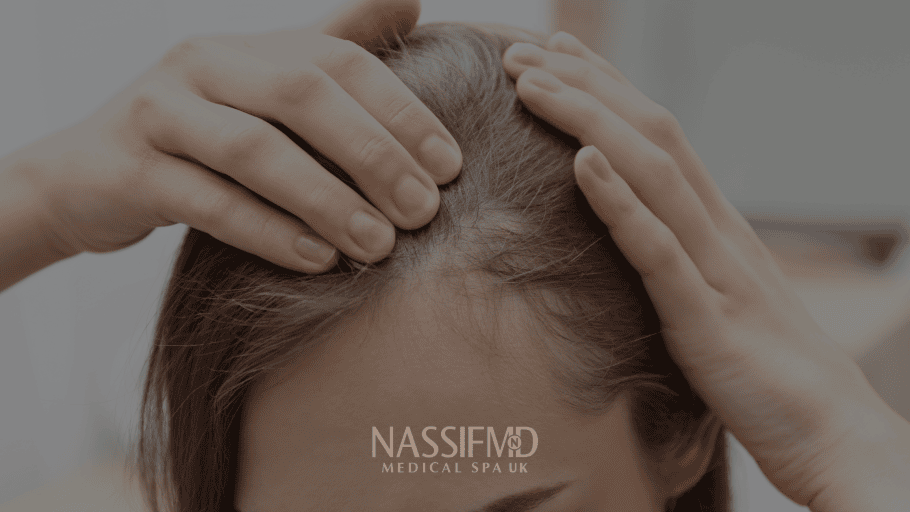
- A wider parting
- A thinner ponytail
- Reduced density around the temples
- More visible scalp
With telogen effluvium, shedding is often relatively diffuse, meaning it affects the scalp more generally rather than creating one clearly defined bald patch.
If you’re experiencing sudden, patchy or unusual hair loss, it is important to have this assessed, as there can be other causes that need to be investigated.
Could nutrition play a role?
One of the biggest considerations when experiencing hair shedding during weight loss is whether your body is receiving enough of the nutrients it needs.
GLP 1 medications can reduce appetite, which can sometimes make it easier to unintentionally consume less food and, consequently, less protein and other essential nutrients.
During significant weight loss, it is important to focus on maintaining a balanced, nutrient rich diet rather than simply concentrating on the number on the scales.
Protein, iron and a range of vitamins and minerals all play important roles in normal hair growth.
If you’re concerned about your nutritional intake or experiencing significant hair loss, speak to your GP or healthcare professional about whether further investigation or blood tests may be appropriate.
What can you do about GLP 1 related hair loss?
If you’ve noticed your hair becoming thinner after starting a GLP 1 medication or going through significant weight loss, you may be wondering whether there is anything you can do.
There isn’t one treatment that is right for everyone experiencing hair shedding.
The first step should always be understanding what is causing the hair loss. Once this has been considered, treatments can be used to support the scalp and hair as part of a personalised approach.
At Nassif Medical Spa, we offer several treatments that may form part of a hair and scalp treatment plan, including PRP, Polynucleotides and HydraFacial Keravive.
PRP for hair loss
Platelet Rich Plasma, or PRP, uses a small amount of your own blood.
The blood is processed to concentrate the platelets and growth factors before the resulting plasma is administered into the scalp.
PRP has been studied as a treatment for certain types of hair loss and is thought to support the environment around the hair follicles.
It isn’t an instant solution and results vary between individuals. However, for suitable patients, PRP for hair loss can be an option for supporting scalp health and hair density.
If you’re experiencing hair shedding following weight loss, we would first want to understand what is happening with your hair and scalp before recommending treatment.
Discover our PRP Hair Treatment
Polynucleotides for hair and scalp health
Polynucleotides have become increasingly popular in regenerative aesthetics and skin health.
These biostimulatory molecules are used to support tissue repair and regeneration and can also be used as part of a scalp focused treatment approach.
When used for the scalp, the aim is to support the overall scalp environment and the health of the tissue surrounding the hair follicles.
As with PRP, polynucleotides are not an overnight solution and aren’t suitable for every type of hair loss.
The key is identifying the underlying concern and determining whether this type of treatment is appropriate for you.
Discover our Polynucleotide Hair and Scalp Treatment
HydraFacial Keravive for the scalp
When we’re talking about hair health, it’s easy to focus entirely on the hair itself.
But your scalp matters too.
HydraFacial Keravive is a treatment designed specifically for the scalp. It uses HydraFacial’s Vortex technology to cleanse and exfoliate the scalp, helping to remove oil, dirt and buildup before hydrating the scalp.
The treatment can then be supported at home with the Keravive Peptide Complex Spray, which is designed to be applied directly to the scalp following treatment.
Keravive isn’t designed to treat every underlying cause of hair loss, but maintaining a clean, hydrated and healthy scalp can be an important part of an overall approach to scalp and hair health.
Discover HydraFacial Keravive for Scalp Health
Could PRP, Polynucleotides and Keravive be combined?
Potentially, yes.
For some patients, combining treatments can provide a more comprehensive approach to scalp and hair health.
For example, PRP or Polynucleotides may be combined with HydraFacial Keravive, depending on the individual’s concerns, scalp condition and treatment goals.
However, we don’t believe in a one size fits all approach.
Someone experiencing temporary shedding following rapid weight loss may require a very different approach to someone experiencing hereditary hair thinning or another underlying condition.
That’s why consultation comes first.
What can you do at home?
Professional treatments are only one part of supporting your hair during weight loss.
If you’re taking a GLP 1 medication, continue to prioritise your nutritional intake and make sure you’re eating a balanced diet with sufficient protein and a variety of nutrients.
Be gentle with your hair too. Excessive heat styling, tight hairstyles and aggressive brushing can put additional stress on fragile hair.
And remember that hair growth takes time.
It can be tempting to look for an immediate solution when you first notice increased shedding, but the hair growth cycle doesn’t work that quickly. Supporting your scalp and hair is a process rather than an overnight fix.
When should you seek advice about hair loss?
If you’ve noticed increased shedding since starting a GLP 1 medication or experiencing significant weight loss, don’t automatically assume it’s something you simply have to live with.
If the shedding is persistent, severe, patchy or accompanied by changes to the scalp, it’s worth having the cause properly assessed.
A consultation gives us the opportunity to understand your concerns, discuss your treatment history and consider whether treatments such as PRP, Polynucleotides or HydraFacial Keravive may be appropriate.
If we feel your hair loss could be related to an underlying medical or nutritional issue that requires further investigation, we’ll advise you to speak with your GP or relevant healthcare professional.
The bottom line
GLP 1 related hair loss can be frustrating, but increased shedding during significant weight loss doesn’t necessarily mean permanent hair loss.
For many people, the hair cycle can recover as the body adjusts and the underlying trigger settles.
The most important thing is not to panic or immediately start trying every hair loss treatment available. First, understand why you’re experiencing hair loss.
From there, a personalised approach can focus on supporting both the scalp and the hair follicles.
At Nassif Medical Spa, treatments including PRP, Polynucleotides and HydraFacial Keravive with Keravive Peptide Complex Spray can form part of a tailored approach to scalp and hair health for suitable patients.
If you’ve noticed increased hair shedding since starting a GLP 1 medication or losing weight and would like to understand your options, book a consultation with our team. We can assess your concerns and talk you through the most appropriate approach for you.


